
Embark on a journey through time and tradition as we unravel the mysteries and marvels of the revered Reishi mushroom, a symbol of holistic health and healing that continues to captivate hearts and minds across the globe.
Defining Reishi Mushroom AKA Ganoderma lucidum
Reishi mushroom, scientifically known as Ganoderma lucidum, is a species of medicinal fungus also referred to as red Reishi or Ling Zhi. Esteemed for its health-promoting properties, it is often called the “Supreme Protector” and is recognized for its adaptogenic qualities, which help the body combat stress.
Reishi mushrooms are not edible in their raw form due to their tough, woody texture, and are instead consumed in extracted forms such as powders, teas, and tinctures.
Historical Significance of Reishi in Traditional Chinese Medicine
Reishi’s use in traditional medicine spans over two millennia, with its first documented mention by Emperor Yan in the ancient Chinese text, the “Divine Farmer’s Classic of Pharmaceutics”.
Revered as the “most superior of all herbs,” Reishi was historically reserved for royalty and the elite in Asian societies due to its rarity and perceived life-extending benefits.
Its use in Traditional Chinese Medicine (TCM) is deeply rooted, where it is believed to impact the heart, lungs, liver, and kidney channels, and to balance life force, or Qi.
Reishi mushroom is known by many names across different cultures, with Ling Zhi in Chinese translating to “Herb of Spiritual Potency” or “Mushroom of Immortality”. It symbolizes success, well-being, divine power, and longevity.
The mushroom’s depiction in ancient art and literature further underscores its importance and the reverence with which it has been held throughout history.
The Three Treasures: Jing, Qi, and Shen
In the context of TCM, Reishi is celebrated for nourishing the “Three Treasures” which are the foundational energies of life. Jing represents the essence of life, related to genetic potential and reproduction. Qi is the vital energy that powers physiological activities and defense mechanisms. Shen is associated with the spirit and mind, encompassing consciousness, emotions, and mental health.
By supporting these three energies, Reishi is believed to harmonize the body’s physical, energetic, and spiritual health.
Through its rich history and continued use in modern wellness practices, Reishi mushroom remains a cornerstone of holistic health, embodying a bridge between ancient wisdom and contemporary science.
The Botanical Profile of Reishi
Scientifically known as Ganoderma lucidum, the Reishi mushroom is a species with a remarkable diversity and a wide geographic distribution.
Found predominantly in hot and humid locations in Asia, it has also been discovered in various regions of North America and Europe.
This polypore mushroom typically grows on hardwoods, and its presence signifies a mature forest ecosystem.
The species’ diversity is vast, with several closely related species such as Ganoderma tsugae and Ganoderma oregonense found in North America, each with unique characteristics and habitats.
The Unique Traits of Different Reishi Varieties
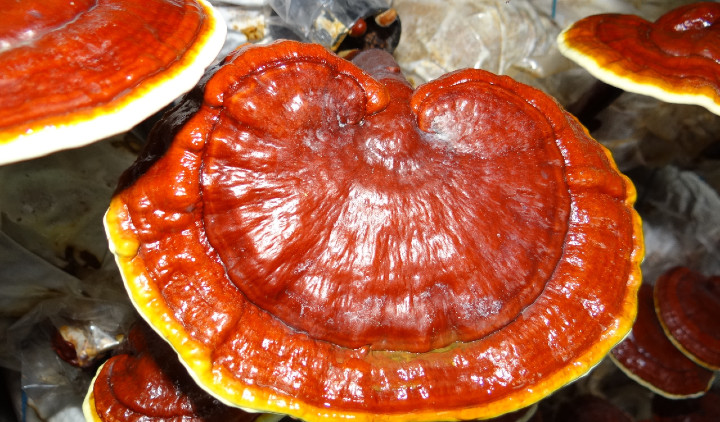
Reishi mushrooms are easily recognizable by their shiny, varnished appearance, often with a reddish hue.
They are known for their tough, woody texture and kidney-shaped cap.
Reishi’s unique feature is its production of spores from the underside of its cap rather than gills, which are released in such quantities that they can often be seen as a fine, brown dust surrounding the mushroom.
Comparison of Red, Black, and White Reishi Varieties
Among the various types of Reishi, the red variety (Ganoderma lucidum) is the most researched and is believed to possess the highest therapeutic value. It is also favored for its higher polysaccharide content, particularly beta-glucans, which are known for their immune-modulating effects
Black Reishi (Ganoderma sinense) and white Reishi, though less common, are also used for their medicinal properties. Black Reishi is often used in traditional medicine for its potential anti-aging properties, while white Reishi, a little less -studied is sometimes used for its purported antioxidant benefits.
The Art and Science Behind Reishi Cultivation
Reishi mushrooms have a distinctive growth pattern, preferring the stumps and logs of dead or dying trees. They are slow-growing, taking several months to develop fully, which presents a challenge for harvesting.
Wild Reishi is rare and sought after, but due to overharvesting and habitat loss, its availability is limited.
This scarcity has led to the cultivation of Reishi, which requires controlled environments that mimic the natural conditions Reishi needs to grow. Cultivation has its challenges, including maintaining the right balance of humidity, temperature, and fresh air, all crucial for producing high-quality Reishi mushrooms with potent medicinal properties.
Reishi’s Traditional, Cultural and Therapeutic Significance
Reishi’s Reverence in Eastern Philosophies and Practices
The Reishi mushroom has been a cornerstone in Eastern medicine for millennia. Its use is deeply rooted in Taoist and Buddhist traditions, where it is revered for its ability to harmonize the body, mind, and spirit.
In Traditional Chinese Medicine (TCM), Reishi is believed to:
- influence the heart, lungs, liver, and kidney channels
- balance Qi (the body’s vital energy)
- calm the mind
- relieving respiratory conditions
- maintain Balance
- increase resilience to stressors of all kinds
Reishi’s Regal Past and Noble Associations
Due to its rarity in the wild and esteemed status, Reishi was historically reserved for Asian nobility and was not accessible to the general public.
It was so highly valued that it was dubbed the “mushroom of immortality,” and was sought after by emperors who believed it could grant them eternal life. This exclusivity added to the mystique and veneration of Reishi in ancient times.

Reishi in Religious and Spiritual Contexts
Reishi’s significance extends beyond its health benefits to religious and spiritual realms. It is often depicted in ancient art, symbolizing longevity and spiritual potency.
In various myths and folk tales, such as the legend of Magu, Reishi is portrayed as a divine herb with transformative powers. This cultural iconography underscores the mushroom’s historical importance as a symbol of well-being and spiritual wisdom.
Modern Rediscovery and Scientific Validation
In contemporary times, the allure of Reishi has been reignited as scientific research begins to validate its traditional uses.
Modern pharmacological studies have begun to explore its potential in supporting cardiovascular health, immune function, and more. As a result, Reishi has made a resurgence as a natural remedy and is now widely available, transcending its once-exclusive status to become a staple in holistic health practices around the world.
Harnessing the Power of Reishi for Health and Wellness
Adapting to Diversity; Reishi as an Adaptogen
The Reishi mushroom, known scientifically as Ganoderma lucidum, is renowned for its adaptogenic qualities. An Adaptogen is a substance that help the body resist stressors of all kinds.
Adaptogens like Reishi can balance the body’s stress response, whether it’s to emotional, physical, chemical, or biological factors. By modulating the hypothalamic-pituitary-adrenal (HPA) axis, Reishi can help reduce chronic stress, improve energy levels, and enhance mental clarity.
Strengthening the Shield: Reishi’s Defense Against Illness, Including Cancer
Reishi mushrooms have been studied for their potential to modulate the immune system. Compounds within Reishi, such as polysaccharides and triterpenes, have been shown to enhance immune cell function and exhibit anti-cancer activities.
These compounds can stimulate the production of natural killer cells and promote apoptosis in cancerous cells, offering a potential complementary approach to traditional cancer treatments.
Heart, Liver, Lungs, and Beyond: How Reishi Supports Vital Organs
Reishi mushrooms offer support for various organ systems. They have been found to have cardioprotective properties, potentially helping to manage blood pressure and cholesterol levels.
The hepatoprotective effects of Reishi can also support liver health, aiding in detoxification processes. Additionally, Reishi’s anti-inflammatory properties may benefit respiratory health by reducing inflammation in the airways.
Anti-Inflammatory and Antioxidant Effects
The anti-inflammatory and antioxidant effects of Reishi mushrooms are significant.
The bioactive compounds within Reishi can inhibit the production of pro-inflammatory cytokines and oxidative stress markers, which are implicated in a range of chronic diseases. These effects not only contribute to reducing inflammation but also protect cellular components from oxidative damage.
Reproductive Health and Hormonal Balance
Reishi mushrooms may also play a role in supporting reproductive health and hormonal balance.
By acting on the endocrine system, Reishi can help regulate hormones that are crucial for reproductive functions. Its adaptogenic properties may also alleviate stress-related hormonal imbalances, contributing to overall reproductive well-being.

Reishi’s Resurgence in the Wellness Scene
Reishi Rising: Embracing Reishi in Today’s Health Practices
Reishi has been a cornerstone in Eastern medicine for centuries. Its integration into modern wellness practices is a testament to its enduring reputation as a potent health ally.
Today, reishi is embraced by holistic health practitioners who value its adaptogenic properties, which help the body resist the numerous stressors we are all facing in today’s world.
It is also increasingly found in mainstream health stores and pharmacies, often in the form of supplements, teas, and powders.
Beyond Cure: Reishi’s Promise in Preventative Healthcare
Preventative healthcare is a growing focus in the medical community, and reishi mushroom is at the forefront of this movement.
Its potential to support the immune system is particularly valued. Regular consumption of reishi is believed to fortify the body’s defenses, potentially reducing the incidence of illness and supporting overall vitality.
This aligns with the shift towards a more proactive approach to health, where the emphasis is on maintaining wellness rather than treating disease.
Reishi’s Potential in Treating Chronic Conditions
Chronic conditions such as heart disease, diabetes, and autoimmune disorders present ongoing challenges to modern medicine.
Reishi mushroom is being studied for its potential role in managing these conditions. Its bioactive compounds, including polysaccharides and triterpenoids, have shown promise in preclinical studies for their anti-inflammatory and immunomodulating effects.
While more research is needed, reishi may one day be an adjunct to conventional treatments for chronic diseases.
Reishi and Mental Health: Anxiety and Sleep
Mental health is an integral part of overall well-being, and reishi mushroom is gaining attention for its potential benefits in this area.
Anecdotal evidence and preliminary studies suggest that reishi may have a calming effect on the mind, which could be beneficial for those experiencing anxiety.
Additionally, its potential to improve sleep quality is of great interest, as sleep is crucial for mental and emotional resilience. The use of reishi as a natural approach to mental health support reflects the growing interest in plant-based remedies and integrative health strategies.
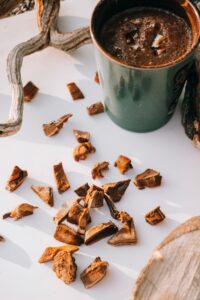
Savoring Reishi, the Superfood Elixir!
Exploring Reishi Consumption Methods; Traditional vs. Modern
Renown for its medicinal properties, Reishi has been consumed for centuries, primarily in Asian cultures.
Traditionally, Reishi was prepared as a hot water extract, similar to tea, or as a powder. The tough, woody texture of the mushroom made direct consumption difficult, so boiling or prolonged simmering was necessary to extract the beneficial compounds.
In contrast, modern methods have evolved to include the production of capsules, tinctures, and extracts that provide a more convenient and concentrated form of Reishi, making it accessible to a wider audience.
The Secret to Superior Potency: The Dual Extraction Technique
Dual extraction is a process that involves both water and alcohol extraction to obtain both water-soluble polysaccharides and alcohol-soluble triterpenes from the Reishi mushroom.
This method is crucial because it ensures a more complete profile of active compounds is available, enhancing the potential health benefits.
The dual extraction process is typically more sophisticated than traditional methods and is indicative of the advancements in modern herbal supplement production.
Infusing Wellness: Ways to Seamlessly Include Reishi in Daily Life
Incorporating Reishi into one’s daily routine can be as simple as taking a supplement or adding a powder to morning beverages like coffee or smoothies – also known as “stacking”.
For those who prefer a more hands-on approach, creating a daily ritual of brewing Reishi tea can serve as a calming practice that also delivers its health benefits.
Consistency is key when it comes to Reishi consumption, as its adaptogenic effects are most pronounced over time.
Recipes and Elixirs
Reishi can be incorporated into a variety of recipes and elixirs to suit different tastes and preferences.
A popular method is to create a Reishi hot cocoa (as above photo) by adding the powder or tincture to warm milk with cocoa and sweetener.
Another option is to blend Reishi tincture into herbal tonics or elixirs that combine multiple adaptogenic herbs for a synergistic effect.
For the culinary adventurous, Reishi can be used in soups and broths, contributing an earthy flavor and its health-promoting properties as well as to chocolate based desserts.
Ultimately, the consumption and preparation of Reishi mushroom should align with individual preferences and lifestyle choices, ensuring that this ancient remedy continues to offer its revered benefits in the modern world.

Future Research; the Path Forward
Gaps and Possibilities in Reishi Research
Despite the extensive history and current popularity of Ganoderma lucidum, there remain some gaps in the research.
Many studies have been conducted on animal models or in vitro, but there is a pressing need for more human clinical trials to validate the efficacy and safety of Reishi mushroom for various health conditions.
Additionally, the mechanisms behind Reishi’s medicinal properties are not fully understood, and further investigation into its bioactive compounds is required to confirm these pathways and their potential health benefits.
Potential for New Discoveries
The complexity of Reishi mushroom’s chemical composition suggests that there may be many undiscovered compounds with potential health benefits.
Future research should focus on isolating and characterizing these compounds, exploring their synergistic effects, and understanding how they interact with human physiology.
Advances in technology and analytical methods will likely play a crucial role in uncovering new therapeutic uses for Reishi.
Concluding Thoughts on Reishi’s Place in Holistic Health
Reishi mushroom has been revered for thousands of years for its wellness enhancing properties and has earned a well-established place in holistic health practices, particularly within Traditional Chinese Medicine.
Its adaptogenic qualities make it a valuable tool for managing stress and promoting overall well-being.
As modern research continues to validate its health benefits, Reishi is likely to become an even more integral component of integrative health approaches, blending ancient wisdom with contemporary scientific understanding.

