

Sick of being sick and tired, of only being given prescription after prescription to treat your symptoms and never getting to the root of those symptoms?
You’re not alone. Millions of people are waking up to the fact that the Western medical system is really good at acute care, but when it comes to whole body healing, that question remains open… it seems this medical model focuses more on managing symptoms. Seems it’s not so great at asking the harder question like: Why is this happening? What is the root cause?
This is what “Amplify” refers to—it’s about turning up the volume on healing and putting a spotlight on the multitude of methods and systems out there, some which have existed for 10,000+ years, as well as the various therapies brought to us thanks to scientific advances, i.e. HBOT – Hyperbaric Oxygen Therapy +++, most of which are backed by data…
Amplify is the 3rd pillar in our exploration of wellness, the other 2 being Nutrify and Detoxify. But Amplify stands out as the wild card!
This is where ancient medicine meets red light therapy, where homeopathy sits next to hyperbaric chambers, and where Eastern wisdom challenges Western assumptions.
The shift away from symptom-chasing medicine isn’t some fringe thing anymore. It’s happening in mainstream hospitals, private practices, and households everywhere. People want more. Your body deserves more– it’s time to demand more …and frankly, the evidence backs it up.
How Western Medicine Won (And Erased Everything Else)
Here’s the thing nobody talks about at your annual checkup: The system that’s treating you today wasn’t inevitable. It was built. Deliberately. And a lot of other healing methods were deliberately destroyed to make room for it.
The Flexner Report Changed Everything
In 1910, a guy named Abraham Flexner wrote a report on American medical schools. Sounds boring, but this thing rewired healthcare forever.
At that time, medical schools in America were all over the place. Some taught homeopathy, some taught herbal medicine, some taught conventional medicine. You could study with multiple healing traditions, and many doctors used several approaches depending on what worked for the patient.
The Flexner Report said: “Nope. This needs to standardize.” It recommended that only schools teaching a specific biomedical model—focused on labs, drugs, and surgery—get accreditation and funding.
Sounds reasonable until you realize what that actually meant: elimination of entire healing schools.
Follow the Money: The Rockefeller Connection

"The Rockefeller Dynasty: America's ..." from www.youtube.com and used with no modifications.
Let’s talk about who was behind this push. John D. Rockefeller controlled about 90% of America’s oil refineries through Standard Oil. When organic chemists figured out how to make drugs from petroleum products, Rockefeller saw the play: Control the oil, control the chemicals, control the medicine. Own the whole pipeline.
Here’s the irony: Rockefeller himself used homeopathic doctors for his personal healthcare. But that didn’t matter. The business opportunity was too big.
The Rockefeller and Carnegie foundations started funding medical schools—but only ones that taught pharmaceutical and surgical medicine. Schools that refused? They lost accreditation, lost funding, and most closed down entirely. Nearly half of all American medical schools vanished within a decade or two.
What Happened to Alternative Medicine Schools?
In 1900, there were 22 homeopathic medical colleges in the United States. By 1923, almost all were gone. Some were forced to drop homeopathy from their curriculum to survive. Some just closed their doors.
Natural medicine, herbal medicine, botanical treatments—all of it got labeled “unscientific” at the exact moment when one specific type of science (the kind that could be patented and sold) became the only acceptable approach.
The Result: A Medical Monopoly
One healing approach won. One way of thinking about the body and disease became official. And if you practiced anything else? You risked losing your license, your reputation, your credibility.
That system is what’s treating you today.
The Spanish Flu: A History Lesson We Forgot
Let’s go back to 1918. The Spanish Flu swept the world and killed millions. And we have actual data on what different treatment approaches did.
When Conventional Medicine Failed
Doctors used what they thought was cutting-edge treatment: massive doses of aspirin. The U.S. Surgeon General recommended it. The Navy recommended it. Medical journals endorsed it.
The death toll was catastrophic. In Philadelphia alone, patients treated with conventional medicine died at rates around 30%.
Here’s something that came out years later: Those massive aspirin doses (8 to 31 grams per day—way higher than we’d ever recommend now) actually caused pulmonary edema. They killed people. And nobody was counting the damage because they were too busy counting all the flu deaths.
What Homeopathic Doctors Actually Did
Meanwhile, homeopathic physicians who were still practicing tracked their own results. What they found should have made headlines but never did.
In Philadelphia (the same city where conventional medicine had a 30% death rate), homeopathic physicians documented outcomes from 26,795 patients. The mortality rate? 1.05%.
That’s 30 times better.
Other data from the same pandemic:
The International Homeopathic Association in New York treated 17,000 patients with 0.25% mortality
Dr. T. McCann in Ohio treated over 1,000 cases without a single death
The District of Columbia Society of Homeopathic Medicine: 1,500 patients, only 15 deaths
This wasn’t accidental. It was consistent. Repeatable. Undeniable.
And yet today? Almost nobody knows this happened. The Spanish Flu is taught as a triumph of medicine, even though half the people being treated conventionally died and most people getting homeopathic treatment lived.
Why History Got Rewritten
After the Flexner Report, homeopathy was on borrowed time. When these incredible outcomes appeared during the Spanish Flu, they threatened the entire narrative that conventional medicine was the only legitimate approach.
So they got buried. Ignored. Written out of the official record.
If 26,795 cases with a 1% mortality rate had gotten the same attention as the failures of conventional treatment, the entire trajectory of American medicine might have been different. But homeopathy was already being dismantled, so the evidence didn’t matter.
The Band-Aid Problem: Treating Symptoms Instead of Causes
Your car’s check engine light comes on. You have a choice: Remove the bulb so you don’t see the warning, or figure out what’s wrong with the engine.
Orthodox Western medicine typically removes the bulb.
This is How Most People Get Treated
Patient comes in with high blood pressure. They get a blood pressure medication. Problem solved (on paper). But nobody asks: “Why is their blood pressure high? Are they stressed? Do they have nutrient deficiencies? Are they eating inflammatory foods? Is their gut in trouble?”
Someone with acid reflux gets acid-blocking medication. But the real question might be: “Why isn’t their stomach producing enough acid, or why isn’t their lower esophageal sphincter working right?”
Chronic pain? Here’s an opioid. Let’s not ask about inflammation, nutrient status, movement patterns, or nervous system dysregulation.
The system works by matching symptoms to drugs. It’s efficient for pharmaceutical companies. It’s not great for actually getting better.
The Side Effect Epidemic
When you’re treating symptoms instead of causes, you’re shutting down your body’s attempt to tell you something’s wrong.
About 8% of hospital admissions today are because of adverse reactions to pharmaceutical drugs. That’s around 100,000 people dying annually from drug toxicity in the U.S. alone. Three times more than drunk driving deaths.
And those are just the catastrophic ones we’re tracking. The smaller stuff—nausea, headaches, hormonal disruption, cognitive issues—that gets normalized as “expected.”
Root Cause Medicine Does It Differently
Root cause medicine asks a different question: What’s the system trying to tell you?
If your body is expressing symptoms, something underneath isn’t balanced. Maybe it’s inflammation. Maybe it’s nutrient depletion. Maybe it’s nervous system stress. Maybe it’s a combination of five things working together to create one symptom.
This approach takes longer. It requires digging. But when you address the cause instead of slapping down the symptom, something wild happens: You actually get better.
Natural vs. Synthetic: The Patent Game Nobody Talks About
Here’s a business problem for pharmaceutical companies: You can’t patent aspirin that comes from willow bark. You can patent aspirin that you synthesized in a lab.
Patent = monopoly = money.
Why Big Pharma Loves Synthetic Drugs
Natural compounds have been used for centuries. They’re public knowledge. No patent possible. But if you slightly modify a natural compound—make it just different enough—suddenly it’s “new” and “inventable” therefore patentable.
The catch? That modification often removes something important or adds something problematic.
Digitalis comes from foxglove. Used for centuries. But foxglove tea was unpredictable in its effects. Digitalis was extracted and refined. That made it more consistent and could be patented.
Salicylic acid comes from willow bark. But modern aspirin isn’t just salicylic acid—it’s acetylsalicylic acid, a modified version that comes with its own set of side effects (like stomach bleeding) that didn’t exist in the original.
What Happens When You Change Nature
Natural products that have been used for thousands of years? They’ve been tested on millions of humans across generations. Problems show up. Bad versions die out. Good versions persist.
Synthetic versions have no such history.
Research actually shows that natural product-based drugs move through clinical trials more successfully than purely synthetic ones. Natural compounds have higher success rates. They’re less likely to fail in development. Yet somehow, the narrative is that synthetic is more scientific.
It’s not about science. It’s about what can be patented and sold as a monopoly.
The Side Effect Connection
Why do so many synthetic drugs come with side effects? Because they’re hitting your biology in a way your biology hasn’t adapted to. Your body knows willow bark. Your body doesn’t know acetylsalicylic acid the same way.
This isn’t theoretical. There’s data. Synthetic opioids are killing tens of thousands of people yearly. Synthetic statins cause muscle pain in many patients. Synthetic hormone replacement therapy increased cancer risk compared to bioidentical hormones.
Natural doesn’t mean safe. Synthetic doesn’t mean better. But when you start from a natural compound that works and then modify it for patent reasons, you can make a solution worse, not better.

"Traditional Chinese medicine (TCM ..." from www.britannica.com and used with no modifications.
Traditional Chinese Medicine: 2,000+ Years Isn’t Just Old—It’s Refined
TCM isn’t just old. It’s old AND it’s been systematically refined and tested on billions of people over millennia. That’s not nostalgia. That’s data.
How TCM Actually Works (Without the Mysticism)
TCM operates on different principles than Western medicine. Instead of “bacteria cause infection,” TCM says: “When Qi (energy) and blood flow aren’t right, symptoms appear.”
The five elements—Wood, Fire, Earth, Metal, Water—aren’t just philosophy. They’re a framework for organizing how different body systems relate to each other. Your liver connects to your eyes, your emotions, your flexibility, and specific times of day. That’s not random. That’s observation about how your body actually works.
Yin and Yang aren’t mystical either. They’re about balance. Too much heat (Yang) or too much cold (Yin), and you get symptoms. TCM fixes it by balancing them back out.
What the Research Actually Shows
TCM has shown effectiveness for upper respiratory infections, depression, chronic pain, and various inflammatory conditions. Some studies are shaky, but many are solid. The problem is that Western research tries to isolate one component of TCM (like one herb) instead of understanding that TCM works as a system.
When you extract one ingredient from a 15-herb formula and test it in isolation, you’re testing something TCM was never designed to do. It’s like taking one instrument out of an orchestra and asking “Does this play well?” Well, no. It plays well with the other instruments.
Why TCM Handles Chronic Stuff Better
TCM excels at conditions that Western medicine struggles with: chronic pain, fatigue, digestive issues, hormonal imbalances, and autoimmune stuff. Why? Because TCM is asking different questions.
Western medicine wants to know: “What’s the diagnosis?” TCM wants to know: “How is your system out of balance?”
If 100 people have “chronic fatigue,” Western medicine will treat them all pretty similarly (usually with “rest and manage symptoms”).
TCM will treat them differently depending on whether the fatigue comes from depleted Qi, poor blood circulation, too much heat, or weak digestion.
Personalization works. One-size-fits-all doe not fir all, especially for chronic stuff.
The Evidence Problem
TCM research has issues—methodology concerns, publication bias, language barriers in accessing Chinese studies. But here’s what’s interesting: Despite these research challenges, TCM continues to be integrated into national health systems in China, India, and several European countries.
If it didn’t work, they’d drop it. Instead, they’re expanding it.
That’s not proof of effectiveness. But it’s worth paying attention to.

Ayurveda: India’s 5,000-Year-Old Personalized Medicine
Ayurveda means “the science of life,” and it literally invented personalized medicine thousands of years before we had that buzzword.
The Three Doshas: Your Personal Constitution
Ayurveda says you’re made of three energetic forces:
Vata (air and space): Rules movement, communication, creativity, nervous system activity. When Vata is out of balance, you get anxiety, insomnia, dry skin, digestive issues.
Pitta (fire and water): Rules metabolism, digestion, transformation, temperature. When Pitta is off, you get inflammation, heartburn, skin problems, irritability.
Kapha (earth and water): Rules stability, immunity, lubrication, structure. When Kapha is stuck, you get heaviness, congestion, sluggish digestion, weight gain.
Most people have one or two dominant doshas (their constitution), and one that’s more easily thrown off (their imbalance point).
This matters because the same problem shows up differently depending on your constitution. Two people with arthritis might need completely different treatment.
One might need warming, moving practices. The other might need cooling, calming approaches.
Prevention is the Real Medicine
Ayurveda’s main focus is not treating disease. It’s preventing it. Keep your system in balance and disease never gets a foothold.
This means: eating for your constitution, moving for your constitution, living seasonally (Vata types need more grounding in fall; Pitta types need more cooling in summer), managing stress, regular cleansing practices.
Most people don’t start with Ayurveda until they’re already sick. But Ayurveda’s real power is showing up when you’re well and keeping you that way.
Real Doshas, Real Results
The doshas aren’t abstract. They’re describing actual physiological differences in how people process food, handle stress, move, and think. Modern research is starting to validate this.
People high in Vata tend to have fast metabolisms and anxious temperaments. Pitta types tend toward inflammation and perfectionism. Kapha types tend toward weight gain and stable moods.
Treat according to these patterns, and you see results. Miss them, and you’re frustrating your patient’s actual constitution with treatments that work for someone else.

Homeopathy: The Most Controversial Healer
Homeopathy remains the most hated form of alternative medicine in Western circles. And yet, it keeps showing up with results that shouldn’t be possible.
How It Works (And Why Skeptics Hate It)
Homeopathy uses the “law of similars”—like cures like. If a substance causes symptoms similar to what a person is experiencing, a highly diluted version of that substance might cure them.
The part that makes people lose their minds: Homeopathic remedies are so diluted that statistically, no molecules of the original substance remain. How can it work if there’s nothing in it?
That’s the question conventional medicine can’t answer, so it dismisses it as impossible. But “impossible based on our understanding” isn’t the same as “proven ineffective.”
The Spanish Flu Evidence (We’re Coming Back to This)
We talked about those 26,795 patients with a 1% mortality rate. This wasn’t luck. This wasn’t placebo. People were dying in the same cities, from the same disease, treated differently.
Something about homeopathic treatment worked during the Spanish Flu. Something about conventional treatment failed. The evidence exists. We just chose not to look at it.
Why It Got Erased
After the Flexner Report, homeopathy was unwelcome in American medical schools. When the Spanish Flu evidence appeared, it threatened the entire narrative about what “real medicine” should be.
Easier to eliminate homeopathy from the system than to explain why homeopathic treatment was more effective.
What Research Actually Says
Modern research on homeopathy is mixed. Some studies show significant benefits beyond placebo. Other studies show no effect. The methodology problem is real—homeopathy is highly individualized, so standardized clinical trials don’t work well.
But here’s what’s interesting: Homeopathy is integrated into national health systems in India, Brazil, and several European countries. It’s used in emergency rooms and regular practices. If it were useless, it would have died. Instead, it’s thriving.
That doesn’t prove it works. But it suggests we should be cautious before dismissing millions of practitioners and patients as delusional.
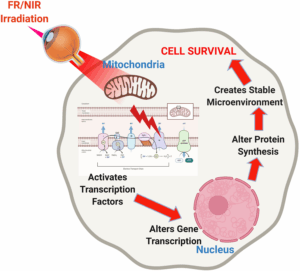
Red Light Therapy: Your Cells Know How to Use Light
Red light therapy, also called photobiomodulation, sounds like pseudoscience. Shining colored light on your body to heal it? Come on.
Except your cells literally evolved to use light. This isn’t strange. It’s basic biology.
How Light Actually Heals
Red light (630 nanometers) and near-infrared light (760-850 nanometers) penetrate your skin and hit the mitochondria in your cells. Inside the mitochondria is an enzyme called cytochrome c oxidase. Light energizes this enzyme, cranks up ATP production (cellular energy), and suddenly your cells have more power to do their job.
More energy at the cellular level = faster healing, less inflammation, better function.
This isn’t magic. This is how plant photosynthesis works. Plants use light to create energy. Your cells have similar mechanisms.
What Red Light Actually Does
Muscle Recovery and Athletic Performance: Athletes use red light before and after training. Result: Faster recovery, less soreness, better performance. The mechanism is straightforward—more cellular energy means muscles repair faster and inflammation drops faster.
Wound Healing: Red light therapy accelerates wound closure, increases collagen production, and stimulates new blood vessel growth. It’s being used in clinical settings for burns, surgical wounds, and chronic ulcers.
Skin Aging: Studies show red light reduces fine lines, improves skin texture, and increases collagen density. One study found significant improvements compared to sham treatment. Your skin is literally getting younger at the cellular level.
Brain Health: Red light can cross the blood-brain barrier and energize brain mitochondria. Early research suggests benefits for traumatic brain injury, stroke, depression, and cognitive decline. The mechanism makes sense—if your neurons have more energy, they function better.
Eye Health: Low-level red light therapy is emerging as a way to slow or stop myopia (nearsightedness) in kids. Studies show real reductions in how much their prescription is worsening.
The Evidence Keeps Growing
Red light therapy has hundreds of peer-reviewed studies backing it up. Some are rigorous. Some have methodology issues. But the consistency across studies is striking: Red light works, especially for things involving cellular energy and inflammation.
And the safety profile? Excellent. Unlike high-energy radiation, red light doesn’t damage DNA. It doesn’t burn. It doesn’t have systemic side effects.

Molecular Hydrogen: The Gas Your Cells Need
Molecular hydrogen (H₂) sounds weird as a health intervention. Hydrogen is… gas. But your cells have actually been using hydrogen for energy for millions of years.
What Hydrogen Water Does
Hydrogen water is regular water with dissolved hydrogen gas. When you drink it, hydrogen gets absorbed into your bloodstream and cells. Once inside, it does something specific: It neutralizes the worst type of free radical (hydroxyl radicals) while leaving the good signaling molecules alone.
This is way smarter than most antioxidants, which just bash all free radicals indiscriminately. Your body actually needs some free radicals for signaling. Hydrogen is selective. It only targets the harmful ones.
Hydrogen For Metabolic Health
A 24-week study gave high-concentration hydrogen water to people with metabolic syndrome. Result: Better cholesterol, better blood sugar control, improved A1c levels, and reduced inflammation markers.
Another study tracked hydrogen water for six months in healthy seniors. Result: Telomeres (the end caps of your DNA that shorten as you age) actually got longer. People’s physical function improved. Sleep improved. No side effects.
Hydrogen and Recovery
Endurance athletes are using hydrogen water for recovery because the mechanism makes sense: Intense exercise creates massive oxidative stress. Hydrogen neutralizes that stress faster than your body normally could.
Studies show faster recovery, less muscle damage, better performance in subsequent workouts.
It’s Safe and Simple
Hydrogen water isn’t a drug. It’s water with dissolved gas. You can’t overdose on it. There are no contraindications. The worst side effect anyone reports is an upset stomach if they drink a bunch on an empty stomach.
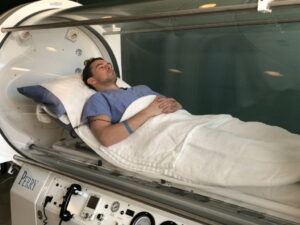
Hyperbaric Oxygen Therapy: Pressure + Oxygen = Healing
HBOT puts you in a pressurized chamber (usually 2-3 times normal atmospheric pressure) where you breathe 100% pure oxygen. It sounds intense because it is. But it’s also FDA-approved for specific conditions and increasingly used off-label with good results.
How HBOT Works
At normal atmospheric pressure, oxygen travels through your bloodstream bound to hemoglobin. In a hyperbaric chamber, so much oxygen dissolves directly into your blood plasma that even tissues with poor blood supply get adequate oxygen.
More oxygen reaching tissues = better healing, better immune function, better cellular repair.
What HBOT Is Approved For
Decompression Sickness: The classic “the bends” when divers surface too fast.
Carbon Monoxide Poisoning: Oxygen floods the brain and organs before CO is too entrenched.
Severe Wounds: Especially diabetic foot ulcers and radiation-damaged tissue. HBOT stimulates new blood vessel growth, accelerates wound closure, and prevents amputation.
Infections: Particularly bone infections and necrotizing fasciitis (that “flesh-eating disease” you hear about). Oxygen kills anaerobic bacteria.
The Off-Label Work
People are using HBOT for traumatic brain injury, stroke recovery, autism, chronic fatigue, and post-COVID symptoms. The evidence is mixed but interesting. The mechanism makes sense—brain injury often involves areas with poor oxygen delivery; HBOT floods the brain with oxygen.
Is It Worth It?
HBOT treatments run about $200-300 per session, and you typically need multiple sessions. Insurance usually covers FDA-approved uses but not off-label ones.
If you have a chronic wound that won’t heal, HBOT might prevent amputation—definitely worth it. If you’re hoping it’ll fix everything, manage expectations.

Essential Oils: More Than Just Smelling Good
Essential oils have been used for thousands of years because they actually do stuff. Modern research is confirming why.
How Aromatherapy Actually Works
When you breathe in essential oil vapors, they don’t just smell good. They trigger your olfactory nerve, which connects directly to your limbic system (your brain’s emotional and memory center). This is why lavender calms you—it’s not psychology, it’s neurology.
Additionally, essential oil compounds can be absorbed through your respiratory system and skin, where they exert direct pharmacological effects.
Which Oils Do What
Lavender: Sleep, anxiety, relaxation. The research is solid. Clinical studies show lavender improves sleep quality and reduces anxiety, not just “feels like it does.”
Peppermint: Digestion, mental clarity, energy. Some evidence for IBS symptom relief and cognitive improvement.
Eucalyptus and Tea Tree: Respiratory support and antimicrobial properties. Research shows activity against various bacteria and viruses.
Frankincense: Anti-inflammatory, mood support. Traditional use for meditation and spiritual practice.
Lemon: Mood and energy. Some evidence for reducing anxiety and supporting mental clarity.
The Safety Issues
Essential oils are potent. Some people react poorly to them. Never use them undiluted on skin unless you know what you’re doing. Some oils interact with medications. Some are problematic if you’re pregnant or nursing.
Also: Oil quality varies wildly. “Essential oil” labeling is unregulated. You can buy cheap trash or quality oils. Source matters.
How to Actually Use Them
Diffusers are the most common and safest method. Topical application requires dilution in a carrier oil (coconut, jojoba, etc.). Internal consumption should only happen under professional guidance because it’s not properly regulated.
The Whole-Person Approach: You’re Not a Collection of Parts
Orthodox medicine treats your body like a car on a lift: Check the engine, check the transmission, check the brakes. If one part is broken, fix it. Done.
Except your body isn’t a car. It’s a system where everything connects to everything else.
How This Actually Works
Your gut bacteria influence your brain health. Your stress levels affect your immune system. Your sleep quality affects your inflammation levels. Your digestion affects your nutrient absorption, which affects your energy, which affects your recovery.
Treat one thing in isolation and you often break something else. Fix the symptom and the system finds a new way to express the imbalance.
The Symptom Migration Problem
Treat depression with SSRIs? Great, mood improves. Also common: Sexual dysfunction, weight gain, emotional blunting.
Lower cholesterol with statins? Good for heart disease risk. Also possible: Muscle pain, cognitive issues, sexual dysfunction.
Suppress acid reflux with PPIs? Reflux stops. Also happens: Vitamin B12 deficiency, calcium absorption issues, gut dysbiosis, increased infection risk.
None of this is accidental. You’re forcing one system back into balance and throwing others out of whack.
Holistic Medicine Connects the Dots
Holistic practitioners ask: “Why does your gut hurt? Is it food sensitivity? Is it stress? Is it dysbiosis? Is it food combining? Is it your gut bacteria composition?”
Different causes need different fixes. One size doesn’t fit all.
This means treatment takes longer to figure out. But when you get it right, you don’t create new problems while solving the old one.
The Future: Why “Both/And” Beats “Either/Or”
The real future of healthcare isn’t about conventional medicine or alternative medicine. It’s about recognizing what each does well and using them together.
When to Use Conventional Medicine
Emergency: Yes. Heart attack, stroke, severe trauma, acute infection—get to a hospital now. Conventional medicine saves lives in emergencies.
Diagnostic clarity: Sometimes you need MRIs and blood tests. Sometimes you need surgery. These are tools conventional medicine excels at.
When alternative approaches don’t work: After six months of acupuncture and herbs, your pain still isn’t better. Time to try conventional approaches.
When Alternative and Traditional Medicine
Chronic disease: Conventional medicine often just manages symptoms. Alternative approaches ask different questions and often get better results.
Prevention: This is where alternative medicine shines. TCM and Ayurveda are built around staying healthy. Conventional medicine focuses on treating disease.
Side effects: If conventional treatment is working but the side effects are brutal, combining with complementary approaches might help both effectiveness and quality of life.
Quality of life: Sometimes conventional medicine extends life but alternative medicine extends living. Red light therapy might not cure cancer, but it improves quality of life during treatment.
The Integration That’s Happening
Functional medicine practices are growing. Integrative medicine is getting added to major medical centers. Acupuncture is covered by some insurance. Hospitals are offering massage and meditation.
This isn’t alternative medicine replacing conventional medicine. It’s both approaches working together, each doing what it does best.
FAQs: Real Questions, Real Answers
Isn’t alternative medicine just placebo?
Placebo is powerful and shouldn’t be dismissed. But red light therapy works on cells. Hydrogen water improves mitochondrial function. These aren’t psychological effects—they’re measurable biological changes. Additionally, homeopathy worked during the Spanish Flu when patients didn’t know they were getting a “controversial” treatment—they just knew it kept them alive.
How do I know what to trust?
Look at consistency (Do multiple studies show similar results?), mechanism (Does it make biological sense?), safety profile (What are the real risks?), and who’s funding the research (Is there financial interest pushing the results?). Skepticism is good. Closed-mindedness is just the other side of gullibility.
Will my doctor take me seriously if I mention alternative medicine?
Some will, some won’t. Finding a practitioner who respects both conventional and alternative approaches is valuable. You don’t need your doctor to believe in red light therapy, but they should be willing to discuss it without dismissing you.
Is alternative medicine expensive?
Varies. Acupuncture might be $100-200 per session. HBOT might be $200-300 per session. Essential oils are cheap. But you know what else is expensive? Lifetime pharmaceutical management of symptoms you never actually fix. Sometimes alternative medicine costs more upfront but saves money long-term.
How long before I see results with alternative approaches?
Depends on the approach and the problem. Red light therapy shows effects in weeks. Herbal medicine might take months. Some people respond quickly; others take longer. This is the other tradeoff with alternative medicine: Sometimes it works slower but more sustainably.
Shouldn’t I just trust my doctor?
Your doctor has training you don’t have in specific areas. That’s valuable. But your doctor also has limitations shaped by their training. They know what they were taught. That’s not the same as knowing everything. Take responsibility for your health. Ask questions. Do your own research. Use your doctor as a resource, not an oracle.
Your Wellness Journey
The narrative we’ve all been told is simple: Orthodox medicine is scientific and proven. Alternative medicine is fringe and unproven.
The reality however, is much more interesting…
Orthodox medicine was chosen through deliberate business decisions and funding strategies, not because it was obviously superior. The Flexner Report happened. Rockefeller funded it. Schools teaching alternative methods were defunded and destroyed. Alternative medicine wasn’t proven inferior—it was actively eliminated.
Meanwhile, evidence keeps appearing that things we threw away actually worked. Homeopathy during the Spanish Flu. Red light therapy for muscle recovery. Molecular hydrogen for cellular health. TCM for chronic conditions. Ayurveda for prevention.
You don’t need to choose one or the other. You need to understand what each approach does well and use it when it’s appropriate.
Your wellness journey, whether you’re looking to nutrify, detox, or amplify your health, or all 3, all the available tools merit consideration; whether it’s ancient systems that have served humanity for thousands of years, modern therapies backed by real research or approaches that ask different questions than what you’re used to hearing…
The system didn’t make room for alternatives because they threatened the profitability of those in the orthodox system. But your health isn’t about profit. It’s about actually feeling your best so that you can live a fulfilling purposeful life with your loved ones.
That’s what amplifying your health actually means. And the best healing approach for you might just be the one you haven’t explored yet…
SOURCES
NCBi/PubMed studies on red light therapy – https://www.ncbi.nlm.nih.gov/pmc/articles/PMC6522196/ (photobiomodulation research)
Mayo Clinic on Hyperbaric Oxygen Therapy – https://www.mayoclinic.org/tests-procedures/hyperbaric-oxygen-therapy/about/pac-20394380
National Center for Complementary and Integrative Health (NCCIH) – https://www.nccih.nih.gov/ (for TCM and CAM information)
Cleveland Clinic on Aromatherapy – https://health.clevelandclinic.org/the-benefits-of-essential-oils/ (essential oils research)
Cochrane Library – Traditional Chinese Medicine Studies – https://www.cochranelibrary.com/ (for TCM evidence base)

